Jain Dietary Practice
Why no root vegetables, why nothing after sunset, and the single principle both rules come from.
Practice
3 min read
Effulgence108, Jain Vegetarianism Illustration, CC0 1.0. Converted to WebP.
One principle, applied to a plate
Every rule of Jain diet comes from ahimsa and nothing else. There are no dietary taboos in Jain dharma, no foods that are unclean, and no ritual purity at stake. There is only one question asked repeatedly: how much life does this cost, and can it cost less.
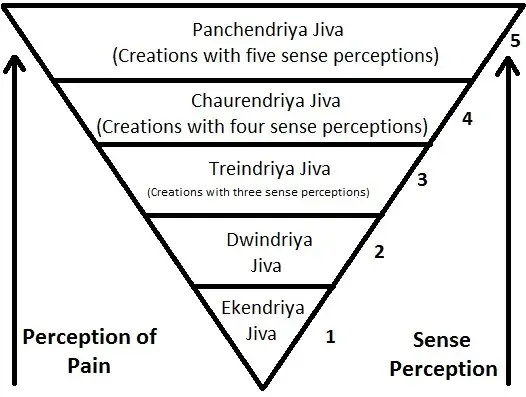
Jain biology grades living beings by the number of senses they possess, from one to five. A human or an animal has five; an insect fewer; a plant has one, touch alone. Since some harm is unavoidable in eating, the practice is to take it at the lowest level available. This is the reason Jains are vegetarian, and it is the same reason the rest of the rules exist.
Why no root vegetables
Two reasons, and they are separate. The first is that Jain texts class roots and tubers as anantkaya, bodies inhabited by innumerable souls rather than one. A potato is not one plant life but a great many sharing a single form, so eating it destroys correspondingly more.
The second is simpler and physical. Pulling a root out of the ground kills the whole plant and disturbs the soil around it, where a great deal of small life lives. A fruit or a grain, by contrast, can be taken without ending the plant that produced it. Where a food can be had without killing the source, that is the one taken.
Why nothing after sunset
Ratri bhojan tyag, giving up food after dark, is among the oldest Jain practices and the reasoning behind it is entirely practical. Insects are drawn to lamps and to food after nightfall, and in the dark they cannot be seen. Food prepared and eaten in daylight can be examined; food eaten at night cannot.
A related practice follows from the same care: water is boiled and then strained through cloth before drinking, and the cloth is rinsed back into the source so that whatever was caught is returned alive rather than discarded. Small details of this kind are where ahimsa is actually lived, rather than in the abstract.
If you are cooking for a Jain guest
- No onion, garlic, potato, carrot, radish, beetroot, ginger or turmeric root. Dried turmeric powder is generally accepted.
- Served and eaten before sunset where possible.
- No eggs, and for many no honey, since taking it disturbs the hive.
- Practice varies a good deal between families. Asking is never taken as rudeness and is much preferred to guessing.
Terms on this page
- Kandmool tyagकंदमूल त्याग
- Giving up root vegetables. Potatoes, onions, garlic, carrots, radishes and ginger are the common examples.
- Ratri bhojan tyagरात्रि भोजन त्याग
- Not eating after sunset or before sunrise, so that the day's food is taken entirely in daylight.
- Anantkayaअनंतकाय
- A body inhabited by innumerable souls sharing it. Root vegetables are classed this way, which is why they are avoided.
Common questions
Do all Jains avoid root vegetables all the time?
No. Ascetics do without exception. Among householders the practice varies widely: some keep it always, some during Chaturmas and the parvas, some not at all. Jain ethics treats it as a vow to be taken up in the measure a person can genuinely keep, not a boundary of membership.