Bhagwan Vimalnath
The thirteenth Tirthankara, and the Moolnayak of this kshetra.
- Position
- Thirteenth of the twenty-four Tirthankaras, between Vasupujya and Anantanath.
- Lanchhanलांछन
- The varaha, the boar, carved on the pedestal beneath the image.
- Body colour
- Golden.
- Parents
- King Kritavarma and Queen Shyama, who is also called Suramya.
- Birthplace
- Kampilya, in present day Uttar Pradesh.
- Janma kalyanakजन्म कल्याणक
- Magh Shukla 3, the third day of the bright fortnight of Magh.
- Mokshaमोक्ष
- Attained at Shikharji, Sammed Shikhar, in present day Jharkhand, where his charan are venerated.
- Attendant deities
- In the Digambar tradition the yaksha Shanmukha and the yakshi Anantamati. The Svetambar tradition names Bhrikuti and Vidita instead.
Who Bhagwan Vimalnath is
Vimalnath is the thirteenth of the twenty-four Tirthankaras of this half cycle of time. The name comes from vimal, meaning stainless, and it is the word the pujan composed for this kshetra plays on throughout.
The attributes below are the ones the traditional Tirthankara lists record. The lanchhan is the practical one: Digambar images are alike by design, so the emblem carved on the pedestal is how any Tirthankara is identified, and Vimalnath's is the boar.
The murti in this sanctum
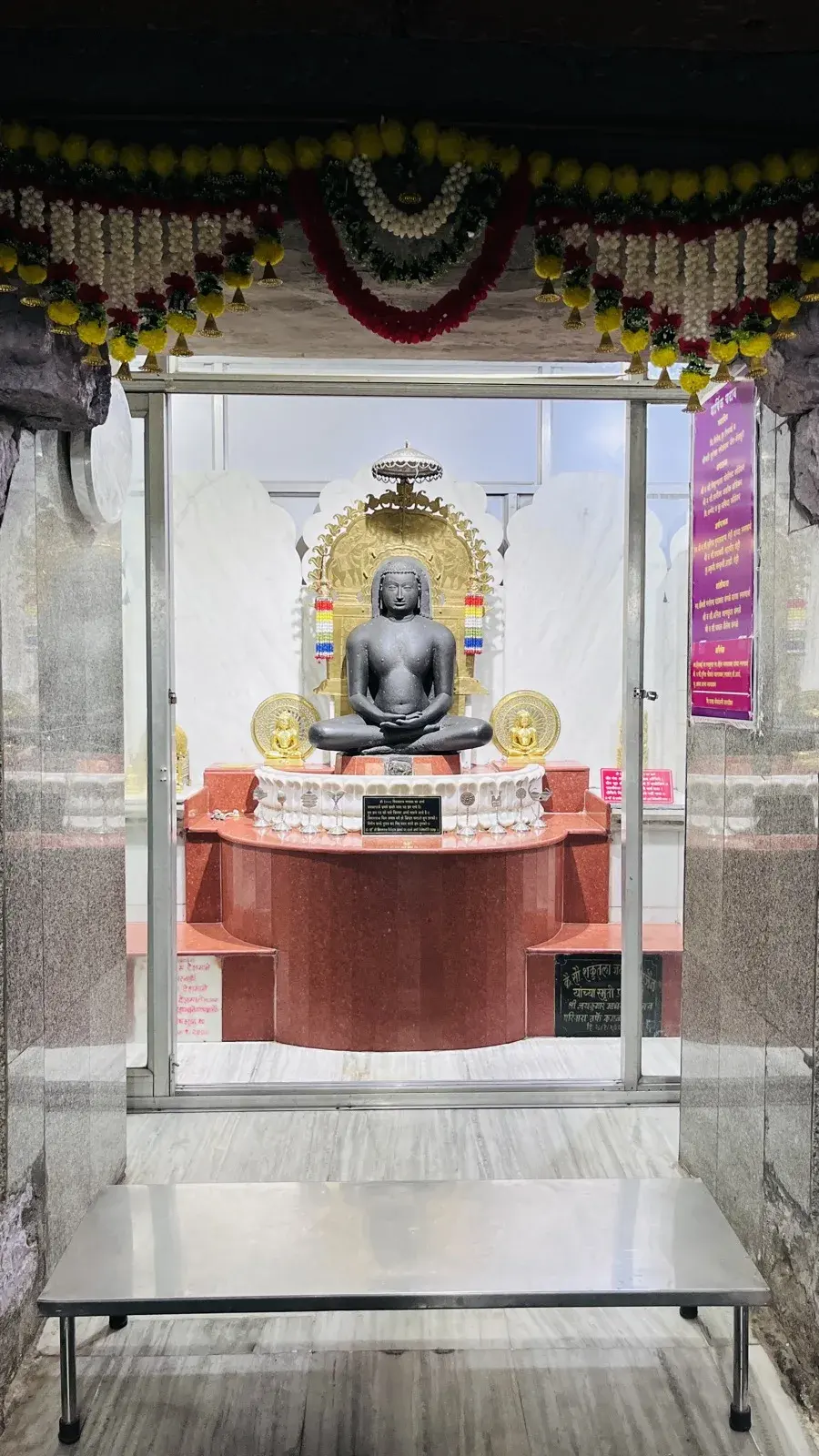
The murti of Shri 1008 Vimalnath Bhagwant is held to belong to the Chaturtha Kaal, the fourth era, and is finely and precisely carved. This is the only Atishay Kshetra in Maharashtra whose Moolnayak is Vimalnath.
Architects, historians and pilgrims who have stood before it have said, repeatedly and unprompted, that they have not seen such a murti anywhere else. The garbhagriha around it is Hemadpanthi, and several other Tirthankara murtis are kept within it.
The murti itself is carved from sandstone, standing about three feet, seated in Padmasana with a serene, finely worked face. It does not carry the Ashtapratihara, the eight auspicious emblems seen around some older Tirthankara images.
Parshvanath, the twenty-third Tirthankara, is placed to the left, shown beneath a seven-hooded serpent canopy with elephants and celestial figures in attendance. A Tirthankara in Kayotsarga, the standing posture of meditation, stands to the right. Further niches around the vedi hold Tirthankara images in both Padmasana and Kayotsarga, among them a panel carrying all twenty-four Tirthankaras together.
What devotees observe
The community's account of this murti is that its face does not hold one expression. Those who take darshan describe a slight smile in the morning, a grave and settled look at noon, and the smile again by evening.
Those who come regularly speak of something plainer as well: that on entering the garbhagriha the mind's agitation subsides, and what is left is the sense the tradition names nissahi, nissahi, the soul's own unpossessing nature. The book records this as the experience of the people who worship here, and it is set down here the same way.
How the murti was found
The senior shravaks and the older residents of the town tell an account of how the murti came to the community. It is tradition rather than record, and the book presents it as such.
Ambajogai was a garrison town under every regime that held it, from Kholeshwar's forces under the Yadavas to the British and the Nizam; the older residents will still point out where the camps stood. Under the Nizam of Hyderabad a military unit called the Golkonda Lancers was stationed here.
An officer of that unit used to put his foot on a small mound near his quarters to mount his horse. The murti lay buried in the earth beneath it. The account says the murti appeared to him in a dream and asked to be given over to its own Jain people. After that, the officer had the ground dug open, took the murti out, and handed it to the Jain community of the town with respect. It was then consecrated in the temple according to the rites.
Darshan and puja
Darshan of the Moolnayak is offered every morning and evening. The daily abhishek and shanti-dhara are performed at eight in the morning, and the sandhya aarti at seven in the evening. The full daily schedule is on the Visit page.